A backorder happens when a customer can still buy a product that isn’t physically in stock, because the seller has committed to fulfilling the order once new inventory arrives. On the surface, it resembles an out-of-stock message, but the operational reality differs a lot. This article defines the term, explains how backorders differ from being out of stock, covers the common causes, and lays out the methods retailers use to keep these orders rare and well-managed.
TL;DR
- Backordered products are still purchasable. The item carries an estimated ship date once stock returns.
- In out-of-stock product status, there is no commitment. A stockout usually means customers can’t order until replenishment.
- Purchase availability is the core difference between backorder and out-of-stock.
- Supply-demand imbalance is the root cause of backorders: demand spikes, supplier delays, weak forecasting.
- Prevention is operational. Use demand forecasting, safety stock, and disciplined reorder points.
- Communication decides whether a waiting customer stays or leaves.
What Is A Backorder? (Meaning)
A backorder is an order accepted for a product that isn’t currently in stock but is expected to return back in stock within a reasonable timeframe. At checkout, a shopper typically sees “available on backorder” alongside an estimated ship date.
Putting an item on backorder is often deliberate. It captures demand the seller can’t immediately satisfy instead of turning the customer away. A modest volume with short lead times reflects healthy inventory management; persistent, long-delayed cases point to forecasting gaps, supplier risk, or thin safety stock. Some sellers even use backordering for seasonal items to avoid holding stock all year.
What Does “Out of Stock” Mean?
Out of stock – also called a stockout – means an item has no available inventory and, often, no confirmed restock date. Unlike the previous case, the customer usually can’t complete the purchase: the buy button is disabled, or the page reads “this product is out of stock,” hinting the item may not return soon, if at all. A discontinued product is the permanent version of the same status.
Backorder vs Out of Stock: Key Differences
The difference in backorder vs out of stock comes down to two questions:
- Can the customer still order?
- Has the seller committed to fulfilling it?
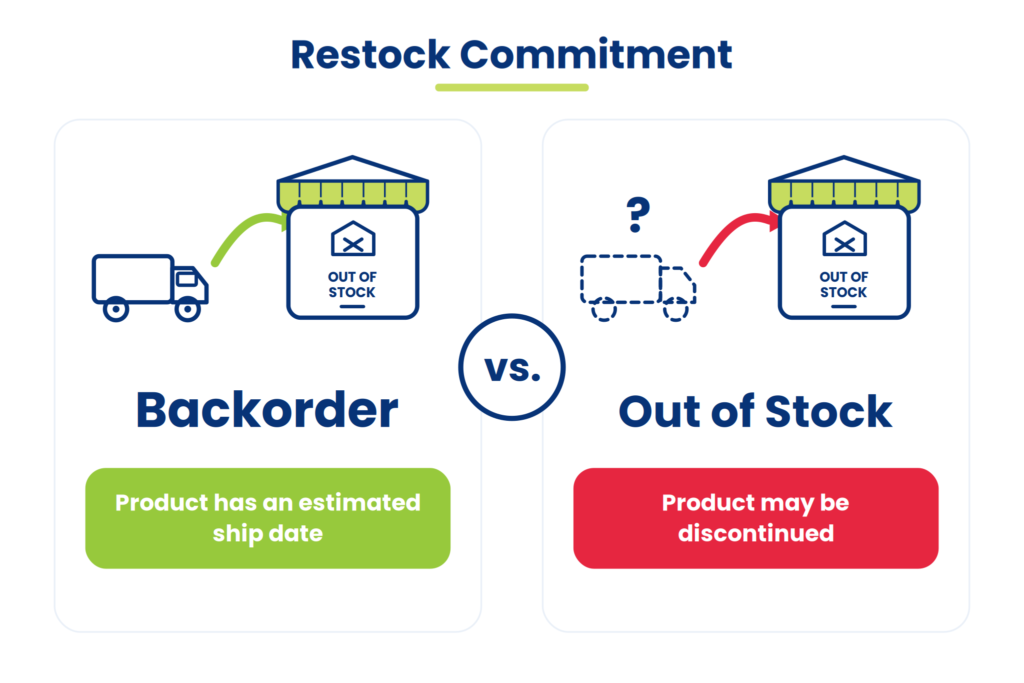
If both answers are yes, the order is accepted and queued against incoming stock. In any other case, the order can’t be fulfilled.
| Factor | Backorder | Out of Stock |
|---|---|---|
| Can the customer order? | Yes. Order is accepted and queued | No. The purchase is blocked |
| Restock commitment | Yes, with an estimated ship date | Often none; may be discontinued |
| Effect on the sale | Captured, delivery on-hold | Typically lost |
| Customer expectation | “Coming soon” | Uncertainty |
| Operational focus | Coordinate suppliers, share ETAs | Replenish or retire the listing |
What Causes Backorders?
Backorders almost always stem from an imbalance between supply and demand. The specific triggers are well understood:
- Demand surges: A viral moment, seasonal peak, or promotion drains stock faster than it can be replaced.
- Supplier delays: Material shortages, factory downtime, or port congestion slow replenishment even when demand is steady. McKinsey’s 2024 supply chain survey found 9 in 10 leaders still faced disruptions, with many adopting dual-sourcing to reduce exposure.
- Long lead times: The longer the lead time between placing a reorder and receiving inventory, the longer a product may remain out of stock.
- Weak forecasting: Predictions built on obsolete data lead to understocking.
- Low reorder points: If the reorder point ignores lead time plus safety stock, replenishment fires too late.
- Record errors: Manual tracking and “phantom stock” mean a business sells units it doesn’t actually hold.
📌 Note: Balance matters more than maximum stock. In early 2026, the U.S. inventories-to-sales ratio sat near 1.26 (about 1.26 months of stock against monthly sales), yet that buffer shifts over time. Too little against demand swings and shortages multiply; too much and capital is trapped in excess inventory.
How To Prevent And Manage Backorders
Some of them are unavoidable; the goal is to make them an occasional, well-handled exception rather than a recurring failure. Here is what you can do:
- Sharpen forecasting: Use historical sales, seasonality, and channel data to anticipate demand instead of reacting to it.
- Right-size safety stock: A buffer absorbs spikes and supplier variability, but oversized buffers waste capital, so the level must be tuned.
- Set and review reorder points: Calculate from lead time plus safety stock and revisit as demand shifts; this underpins most inventory replenishment methods.
- Diversify suppliers: A second qualified source gives you a fallback when one runs into trouble.
- Run cycle counts: Reconciling physical stock against records catches discrepancies early.
- Work from real-time data: Connected systems and a capable WMS give cross-channel visibility. Many brands gain this control through a third-party logistics (3PL) provider rather than building it in-house.
- Communicate proactively: A clear ETA and honest updates keep customers waiting rather than canceling.
Build A Stronger Inventory Operation With Nimbl
Backorders are ultimately a fulfillment problem; they surface where forecasting, replenishment, and real-time visibility break down. Nimbl operates as an extension of your team, moving orders from checkout to customer doorsteps with precision and control. Our 3PL logistics solutions provide real-time inventory visibility, reorder-point tracking, and disciplined pick and pack workflows.
If you care to bring more clarity to your stock handling, we should work together.
Frequently Asked Questions
What Does Backorder Mean?
It means an item is temporarily out of stock but still available to buy, with the seller committed to shipping once new inventory arrives. The order is accepted now and fulfilled later.
How Long Does A Backorder Take To Ship?
It depends on where the delay sits in the supply chain. Many clear within a few days to a few weeks, and around 30 days is a common limit before a retailer reassesses or cancels.
Does Backorder Mean Sold Out?
Not quite. Sold out, or out of stock, usually means you can’t buy the item at all. Backordered means it’s temporarily unavailable but still purchasable, with a restock and ship date expected.
What Happens If Someone Buys Something On Backorder?
The order is accepted and queued against incoming stock. There is generally an estimated ship date, payment may be authorized near shipping, and the item ships once replenishment arrives.
What Is The Back Stock’s Meaning?
Back stock is unsold inventory held in reserve storage, behind the sales floor or pick face, waiting to replenish forward locations as stock sells down.