The last mile delivery has become the most visible and most scrutinized stage of the supply chain. It is where cost, speed, service quality, and customer expectations collide. As e-commerce volumes scale and delivery expectations compress, last-mile delivery has moved beyond execution. It is now a strategic lever that directly shapes cost control, customer experience, and sustainable growth.
For brands operating at scale, performance in the final mile directly influences margin protection, customer loyalty, and long-term competitiveness. This guide explains what last mile delivery is, how it works, and how disciplined execution turns it into a measurable advantage.
What Is Last-Mile Delivery?
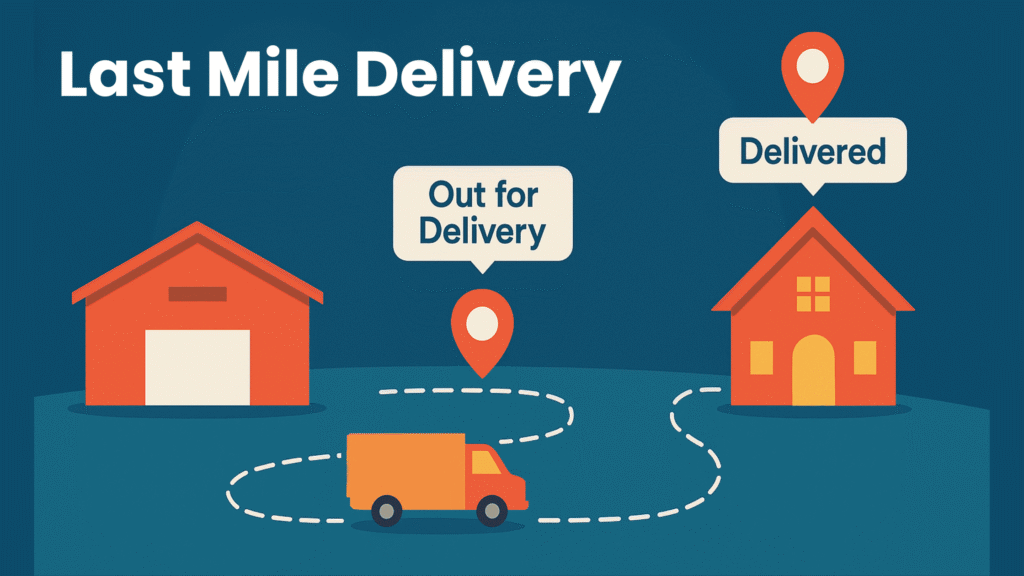
Last-mile delivery refers to the final leg of a shipment’s journey: from a fulfillment center or distribution node to the end customer. This destination is typically a residence, retail location, or business facility.
The objective is simple but demanding: complete delivery quickly, accurately, and at the lowest possible unit cost. The complexity lies in variability: dense urban routes, rural distances, fluctuating demand, and rising service expectations.
The term final mile delivery is often used interchangeably, especially in retail and small parcel networks, but the operational challenge remains the same: executing thousands of commercial, time-sensitive drops with precision.
First Mile vs Last Mile Delivery
While first mile and last mile delivery are part of the same supply chain, they behave very differently. The first mile (moving goods from manufacturers or suppliers into distribution networks) benefits from consolidation and predictability.
The last mile is fragmented, labor-intensive, and highly sensitive to disruption. This is why it typically represents the highest cost per unit and the greatest risk to service levels.
What Does A Last-Mile Carrier Do?
A last-mile carrier is responsible for moving parcels from a local node to their final destination. Unlike line-haul transportation, last-mile carriers operate shorter routes with frequent stops and direct customer interaction.
Last-mile delivery contracts typically define service levels, coverage areas, delivery windows, and performance benchmarks.
Some retailers and marketplaces build proprietary fleets; others rely on regional or national partners. Large players like Amazon have invested heavily in controlling this layer to improve speed and reliability, while many brands achieve better economics by orchestrating multiple carriers through 4PL-enabled networks.
Last Mile Delivery Process – 5 Steps
- Order capture and visibility: Orders are entered into a centralized system and immediately become trackable. This is where last mile tracking begins, creating transparency for both operators and customers.
- Arrival at a local node: Shipments move into a last mile distribution center or local hub, where they are staged for outbound delivery. Speed and accuracy here directly influence delivery cut-off times.
- Sorting and route assignment: At the last mile sorting center, parcels are grouped by geography, service level, and route density. Advanced sorting logic reduces total miles driven and improves drop efficiency.
- Scan-to-load execution: Parcels are scanned before loading to confirm assignment and update status. This step is critical for traceability, accuracy, and exception prevention.
- Delivery and proof: The shipment reaches its final destination, and proof of delivery is captured digitally. Status updates close the loop for customers and internal teams.
The Cost Reality Of Last Mile Delivery
Last mile delivery is consistently the most expensive stage of retail logistics. Recent research estimates that it can account for up to 53% of total delivery costs in retail supply chains.
Without deliberate last mile delivery optimization, profitability erodes quickly, especially as expectations shift toward same-day or next-day service. This is why many brands turn to 3PL last mile delivery models that combine shared infrastructure, carrier networks, and execution technology.
KPIs That Define Last Mile Performance
A disciplined operation tracks a defined last mile delivery KPI framework. Common metrics include:
- On-time delivery rate
- Cost per stop & cost per mile
- First-Attempt Delivery Success (or First Attempt Delivery Rate (FADR)
- Route Deviation Frequency
- Average delivery time
- Exception and return rates
These indicators transform last-mile delivery from a black box into a controllable performance domain.
Innovations In Last-Mile Delivery
Mobile Inventory And Predictive Positioning
Upselling is evolving from a checkout tactic into a fulfillment strategy. Data-driven demand forecasting enables inventory to be positioned closer to buyers – sometimes even on vehicles. By combining demand forecasting with real-time inventory positioning, forward-thinking operators treat delivery assets as mobile inventory nodes, creating incremental revenue opportunities at the point of delivery.
On-Demand, Next-Generation Delivery Methods
On-demand drivers give last-mile networks flexibility, allowing capacity to scale quickly during demand spikes without adding permanent cost. Emerging solutions like delivery robots and drones extend coverage further, helping overcome labor shortages and geographic constraints while maintaining fast delivery expectations.
As consumers buy a wider range of products online, including perishables, last-mile execution needs to adapt to tighter handling, timing, and temperature conditions, as well.
Improved Traceability
Recent research finds that 93 percent of consumers want to stay informed throughout the delivery journey, from in-transit status to final arrival. Modern last-mile operations prioritize end-to-end traceability. Real-time tracking, GPS visibility, and digital proof of delivery reduce loss, limit disputes, and increase customer confidence, turning transparency into a measurable driver of service quality and operational control.
Micro-Fulfillment Networks
Same-day and rapid delivery expectations are driving denser ecommerce fulfillment networks. Market leaders have invested heavily in localized hubs to compress delivery windows, pushing competitors to expand micro-fulfillment capacity as speed becomes a baseline requirement, not a differentiator.
Top Last-Mile Carrier Providers
Several national carriers play a critical role in final mile execution:
- FedEx – Known for time-definite residential delivery and network reliability.
- UPS – Offers advanced routing, access points, and end-to-end visibility.
- USPS – A key partner for residential reach and hybrid last-mile coverage.
Most high-performing networks combine multiple carriers rather than relying on a single provider.
Benefits Of Last Mile Delivery Optimization
The benefits of last-mile delivery extend well beyond faster shipping:
- Higher customer satisfaction through reliable, transparent delivery,
- Lower unit costs via route and capacity optimization,
- Stronger brand reputation through consistent service,
- Actionable data to guide continuous improvement,
- Scalable infrastructure that supports growth without linear cost increases.
Together, these outcomes create meaningful last mile delivery opportunities for brands focused on sustainable expansion.
Connecting The Last-Mile Delivery Dots With Nimbl
For us, last-mile delivery is not a standalone service. We work across many carrier networks, retail distribution nodes, and technology layers to align execution with your growth strategy.
By integrating systems, automations, and infrastructure, Nimbl enables high-volume operations to scale without sacrificing accuracy or service quality. If your operation depends on speed, visibility, and control in the final mile, our fulfillment experts can help you design a network that performs under pressure.
Last Mile Delivery FAQs
What Is Meant By Last Mile Delivery?
Last-mile delivery is the final step of the shipping process, where goods move from a last-mile sorting and distribution center or local hub directly to the end customer.
How Does Final Mile Delivery Work?
Orders are sorted locally, assigned to routes, tracked in real time, and delivered with digital proof of completion.
What Is The Difference Between Carrier Delivery And Last Mile Delivery?
Carrier delivery may include long-haul transport, while last-mile delivery focuses specifically on the final customer handoff.
What Does It Mean When The Package Has Arrived At The Last Mile Delivery Station?
It indicates the shipment is at a local dispatch point and scheduled for imminent delivery.