Value-added warehousing is redefining how modern supply chains operate. With all the knowledge and technology built around order fulfillment, product shipping can go the extra mile and improve how products are prepared, positioned, and delivered.
For e-commerce brands, these services create measurable advantages by enabling faster, more flexible, and scalable fulfillment operations.
TL;DR
- Value-added warehousing connects storage, customization, and distribution into one coordinated system.
- Services like kitting, packaging, and labeling improve execution and highlight brand presence.
- This enables better margins, stronger brand experiences, and the agility to respond to market changes without operational disruption.
- Choosing the right value-added warehousing partner determines how effectively these services translate into sustained operational performance and long-term growth.
What Are Value-Added Warehousing Services?
Value-added warehousing goes beyond storing and shipping products. It includes services that improve how your products are prepared, handled, and delivered. With value-added warehousing and distribution, tasks like kitting, custom packaging, quality checks, and returns processing help streamline operations and create a better customer experience upon delivery.
The Value-Added Services Process
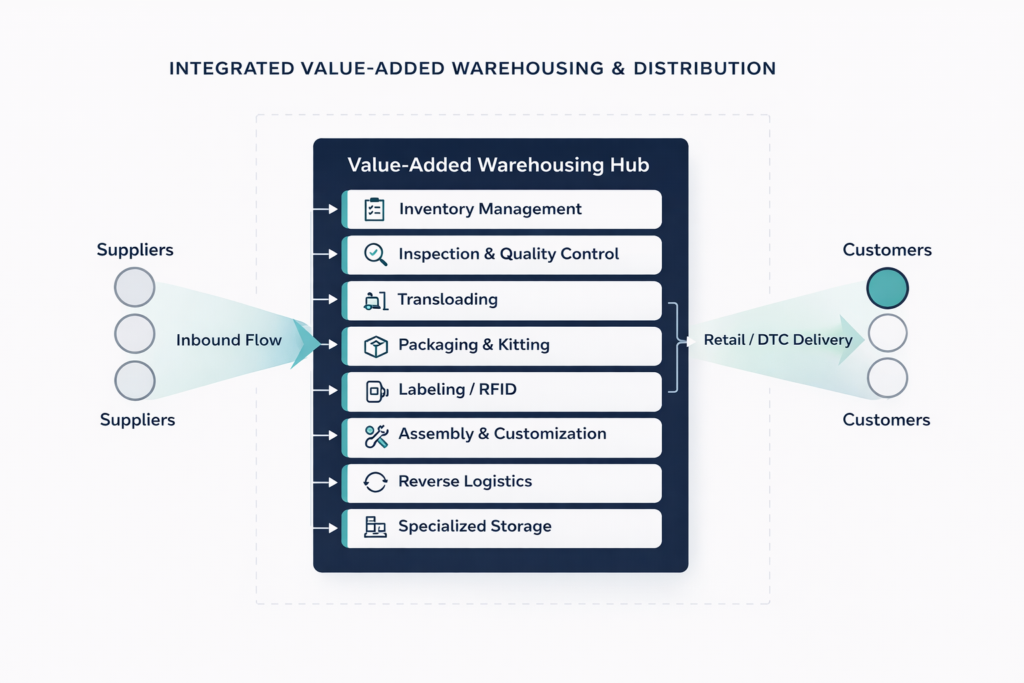
Value-added warehousing transforms a plain warehouse into an active execution hub within the supply chain. Instead of simply holding inventory, products move through incremental steps like kitting, packing, and labeling, before leaving the establishment.
These services convert bulk inventory into retail-ready goods, reduce handling across multiple touchpoints, and accelerate time-to-market. By consolidating these activities in one location, you improve accuracy, lower operational friction, and ensure products meet channel-specific requirements at the point of dispatch.
7 Benefits Of Value-Added Services
Value-added services create a high-impact system that offers businesses real-time control and flexibility. It also allows faster delivery, lower costs, and consistent execution across many channels, helping brands scale efficiently while maintaining service quality and operational precision.
1. Memorable Deliveries & Unboxing
Packaging is no longer a protective-only element. It can become a direct extension of your brand. Through value-added services, you can have custom packaging, inserts, and labeling that create a consistent and memorable unboxing experience.
This strengthens brand perception, increases customer engagement, and differentiates products in competitive markets, especially in e-commerce, where presentation directly influences retention and repeat purchases.
Options you have for custom packaging:
- Recyclable and eco-friendly packaging materials
- Packaging made from recycled content
- Custom colors, typography, and branded design
- Personalized thank you notes, inserts, or offers
- Premium elements like tissue, embossing, or magnetic closures
- Discreet packaging to conceal sensitive or high-value orders
2. High Order Accuracy
Accuracy plays its role in order fulfillment, especially as order volumes scale across multiple channels. Through barcode scanning, standardized workflows, and WMS-driven validation, value-added services reduce picking and packing errors before they reach your customer. This minimizes returns, prevents costly reshipments, and protects brand reputation.
How high accuracy is achieved:
- Barcode scanning and SKU verification at each step
- WMS-driven pick, pack, and validation workflows
- Standardized packing procedures across all orders
- Quality control checkpoints before shipment
- Real-time inventory synchronization across channels
3. Lower Transportation Costs
Value-added warehousing and distribution reduces transportation spend by optimizing how and where inventory is stored and shipped. By positioning products closer to demand and consolidating shipments, you avoid unnecessary distance, zone fees, and split deliveries. This results in more predictable shipping costs and improved margin control without compromising delivery speed.
How costs are reduced:
- Strategic inventory placement across fulfillment centers
- Shipment consolidation and zone skipping strategies
- Optimized carrier selection and routing
- Reduced split shipments across multiple locations
- Data-driven shipping and fulfillment decisions
4. Adaptability To Market And Demand Changes
When market demand shifts quickly, small mistakes scale with it, eroding customer trust faster than teams can recover. Value-added services can turn this disruption into an opportunity; they help you respond better to volatile demand and win over indecisive customers. If you consistently deliver better than the competition, customers naturally start choosing you over others.
Agility:
- Enables rapid inventory reallocation to match shifting demand.
- Supports quick adjustments to fulfillment workflows and priorities.
- Allows faster response to demand spikes or sudden slowdowns.
- Reduces risk by adapting operations before disruptions escalate.
- Maintains service levels despite uncertainty in supply and demand.
5. Increased Operational Efficiency
Value-added services streamline fulfillment by consolidating multiple processes into a single, coordinated workflow. Instead of managing separate vendors or steps, businesses execute packaging, labeling, and assembly in a single environment. This reduces handling, eliminates redundancies, and improves overall throughput across the distribution process.
How efficiency is improved:
- Centralized execution of multiple fulfillment tasks,
- Reduced handling and movement between facilities,
- Automated workflows through WMS and OMS systems,
- Standardized processes across all operations,
- Faster order processing and throughput.
6. Promotions & Offers Support
Promotions, bundles, and limited-time offers require operational flexibility that traditional warehousing cannot support. Value-added warehousing enables rapid creation of promotional kits, special packaging, and campaign-specific configurations. This allows you to execute marketing initiatives quickly without disrupting core fulfillment operations.
How promotions are supported:
- On-demand kitting and bundling for campaigns,
- Custom packaging for seasonal or promotional offers,
- Fast reconfiguration of SKUs and product sets,
- Scalable labor to support demand spikes,
- Coordination between marketing and fulfillment execution.
7. Reduced Working Capital Tied Up In Operations
Value-added warehousing helps you reduce working capital through a more strategic approach to storing, configuring, and deploying inventory. By holding components instead of finished goods and delaying final assembly, businesses avoid excess inventory. This approach frees up cash while maintaining the flexibility to meet demand in time.
How working capital is reduced:
- Inventory pooling across components instead of finished kits,
- Reduced price per unit, since there is a smart storage capability,
- Improved inventory turnover and cash flow efficiency.
Value-Added Warehousing Services Ecommerce Brands Should Prioritize
Kitting And Assembly Services
Kitting combines multiple SKUs into ready-to-ship units tailored for specific offers, channels, or customer segments. This is especially valuable for subscription boxes, bundles, and promotional kits. By centralizing kitting and assembly within the warehouse, businesses reduce handling complexity, shorten fulfillment time, and improve consistency.
💡 Beyond operational efficiency, kitting also supports revenue growth by enabling curated product experiences that increase average order value and simplify purchasing decisions.
Custom Packaging & Presentation
Custom packaging transforms fulfillment into a branded experience. A consistent visual identity across every shipment ensures that every delivery reinforces brand positioning and meets customer expectations.
💡 A well-executed unboxing experience increases perceived value, encourages social sharing (user-generated content), and strengthens customer loyalty in highly competitive ecommerce environments.
Returns Management And Reverse Logistics
Reverse logistics are an operational pain point in e-commerce logistics, but they can become a controlled and strategic process. Structured returns management ensures fast intake, inspection, and disposition decisions – restocking, refurbishing, or disposal. This minimizes inventory loss and accelerates recovery cycles. At the same time, return data provides actionable insights into product performance and customer behavior.
Proactive Exception Handling
As part of 3PL customer service, proactive delivery exception handling ensures disruptions are identified, prioritized, and resolved before they impact fulfillment performance. Instead of reacting to delays, inventory mismatches, or carrier issues after they occur, systems trigger real-time alerts and corrective actions early.
This reduces delays and avoids unnecessary costs such as expedited shipping or penalties while maintaining service reliability. As a result, operations remain predictable, and customer experience stays consistent, even in complex, high-volume environments.
Quality Control
Quality control ensures that every product shipped meets defined standards before reaching the customer. Through inspections, verification processes, and compliance checks, businesses reduce defects, returns, and customer complaints. This is particularly critical for regulated, fragile, or high-value products. By working with a fulfillment partner that applies quality control directly into their workflows, brands protect their reputation and ensure that operational execution aligns with product expectations.
Custom Labeling
Custom labeling enables brands to adapt products for different markets, channels, and compliance requirements without changing core inventory. Labeling includes barcodes, regulatory information, and branded elements applied at the fulfillment stage. This flexibility allows you to localize products and support regulatory requirements with confidence. It also reduces the need for pre-labeled inventory, improving agility and reducing complexity across your supply chain.
Value-Added Warehousing, Executed At Nimbl Standards
Selecting the right value-added warehousing partner comes down to technology, service scope, network reach, and operational reliability. With Nimbl, you gain a performance-driven fulfillment environment powered by advanced WMS and OMS integrations, scalable infrastructure, and precision execution across every workflow.
From initial setup through day-to-day execution, our team builds structured workflows that evolve with your operations. If you’re looking to move beyond basic fulfillment, Nimbl provides the operational clarity, adaptability, and execution discipline required to support long-term growth.
FAQs
What Is VAS In 3PL?
VAS (Value-Added Services) in 3PL refers to additional services beyond storage and shipping, such as kitting, labeling, packaging, and returns handling.
What Is Value-Added Warehousing?
Value-added warehousing enhances traditional storage by integrating services like kitting, packaging, and quality control to improve efficiency and customer experience.
What Is Value-Added Distribution?
Value-added distribution combines fulfillment with services like customization, labeling, and routing to deliver products aligned with specific customer and channel requirements.
Can Value-Added Warehousing Give Smaller Brands A Competitive Edge?
Yes. Value-added warehousing enables smaller brands to deliver customized experiences, improve efficiency, and compete with larger retailers on speed, quality, and differentiation.
What Is An Example Of A Value-Added Function In A Warehouse?
A common example is kitting, where multiple products are assembled into one ready-to-ship unit, improving efficiency and supporting bundled offerings.
What Is A Value-Added Service Example?
Custom packaging is a value-added service that enhances branding, improves the unboxing experience, and increases perceived product value and customer engagement.
What Are Value-Added Services In Warehousing?
Value-added services include kitting, labeling, packaging, quality control, and returns processing, all designed to improve operational performance and customer satisfaction.
What Are Value-Added Logistics Services?
Value-added logistics services extend beyond transport and storage to include customization, assembly, and routing optimization processes that improve supply chain performance and flexibility.