For supply chain leaders, the cost of not knowing where stock sits creates real, measurable problems. It shows up as canceled orders, oversold SKUs, idle pickers, and capital trapped in product nobody is moving. Inventory visibility is the ability to see, in real time, what you have, where it is, and what is committed. This guide covers the seven benefits that matter most to operators, the challenges that erode them, and how to improve inventory visibility across your network.
TL;DR
- Inventory visibility in supply chain operations means real-time, location-aware insight into stock levels, status, and movement across warehouses, channels, and in-transit shipments.
- It directly affects fulfillment accuracy, working capital, customer experience, and disruption response.
- The biggest payoffs: fewer stockouts, lower carrying costs, faster fulfillment, smarter forecasting, stronger omnichannel performance, better resilience, and tighter cross-functional alignment.
- Common blockers: legacy systems, manual cycle counts, fragmented data, and gaps beyond tier-one suppliers.
- The fix usually requires three things together: a connected WMS, scan-based data capture, and integrations across sales channels.
What Is Inventory Visibility?
It is the ability to track and verify the quantity, location, and status of every SKU across the supply chain, from inbound receipt through storage, picking, fulfillment, and returns. Real-time inventory visibility captures changes as they happen: a unit reserved, a pallet received, a return inspected, a shipment in transit.
Limited inventory visibility carries financial weight. Excess inventory ties up working capital that could fund growth, and without an accurate view, businesses overcompensate; too much safety stock in some SKUs, not enough in others.
Why Inventory Visibility Matters In The Supply Chain
The data proves the point clearly. In McKinsey’s most recent supply chain leader survey, only 30% of respondents reported good visibility beyond their tier-one suppliers, down from 56% two years earlier. Disruptions often originate deep in the supply chain, and once they hit, response cycles average two weeks; far longer than weekly sales-and-operations execution.
For brands selling across DTC, retail, and marketplace channels, weak inventory visibility supply chain practices translate into oversells, late shipments, and chargebacks. A strong real-time picture supports accurate delivery promises, tighter inventory replenishment cycles, and credible commitments across every channel.
7 Inventory Visibility Benefits
Below are the seven benefits of inventory visibility that consistently appear in mature, transparent operations.
1. Fewer Stockouts & Less Excess Stock
Real-time data lets teams trigger replenishment before product runs out and avoid duplicate purchase orders that lead to overstock. Customer-facing availability improves, and capital stops sitting on slow-moving SKUs. For brands tracking GMROI or inventory turnover, this is where the discipline shows up first on the P&L.
2. Lower Carrying Costs
When you know exactly what you hold, you stop hedging with unnecessary safety stock. Storage, insurance, depreciation, and inventory carrying costs (often run 20% to 30% of total inventory value) all decline. A current view also surfaces obsolete or slow-moving stock earlier, so it can be discounted or written off before it consumes more space.
3. Faster, More Accurate Order Fulfillment
Pickers cannot move quickly through stock they cannot find. With scan-verified location data flowing through a warehouse management system, fulfillment teams reduce search time, improve order accuracy, and ship on schedule.
The operational impact multiplies across ecommerce, retail, wholesale, and marketplace channels. E-commerce fulfillment, retail distribution, and bundled kits all benefit from the same accurate inventory pool.
4. Stronger Omnichannel Promise Management
Selling through DTC, marketplaces, and retail means the same inventory often supports multiple channels simultaneously. Without real-time stock visibility, a single item can be promised to multiple buyers. With the right systems in place, brands can reserve inventory by channel, protect order commitments, and give customers more accurate delivery dates. This is what keeps omnichannel fulfillment reliable.
5. Better Demand Forecasting
Forecasts are only as accurate as the data feeding them. Real-time stock signals support stronger retail demand forecasting. Teams spot inventory velocity changes faster, identify trending SKUs earlier, and adjust purchasing before a forecast miss becomes a stockout.
6. Improved Supply Chain Resilience
A current view of inventory helps teams respond faster when something goes wrong. If suppliers are delayed, weather disrupts shipping, or a carrier misses a pickup, teams can act quickly. They can reroute orders, fulfill from another location, or offer a replacement SKU before the issue affects the customer.
7. Cross-Functional Alignment Across Teams
Procurement, fulfillment, finance, and customer service make different decisions on the same data. When that data drifts between systems, decisions drift with it.
⚠️ Procurement reorders SKUs the warehouse already has staged.
⚠️ Finance reports stock levels that no longer match the floor.
⚠️ Customer service quotes lead times that the operations team can’t meet.
A shared, real-time picture closes those gaps. Teams plan, commit, and respond to customers from the same numbers, which reduces internal rework and protects the customer experience downstream.
Common Inventory Visibility Challenges
Most operators know they should improve the picture. The reasons it remains hard are consistent across mid-market brands.
Inventory Visibility Challenges For Medium-Sized Businesses
| Challenge | Operational Impact |
|---|---|
| Legacy ERP or spreadsheet tracking | No real-time updates; data is hours or days old |
| Manual cycle counts | Errors and labor cost compound at scale |
| Disconnected sales channels | Same unit sold across two channels |
| Limited supplier transparency | Disruptions reach you before warning signs do |
| Unrecorded shrinkage or breakage | Stock records drift from physical reality |
| Fragmented WMS / OMS / ERP | Decisions made on different versions of the truth |
Data quality erodes wherever entries are captured manually or when two systems do not “talk” to each other.
How To Improve Inventory Visibility
Three changes do most of the work.
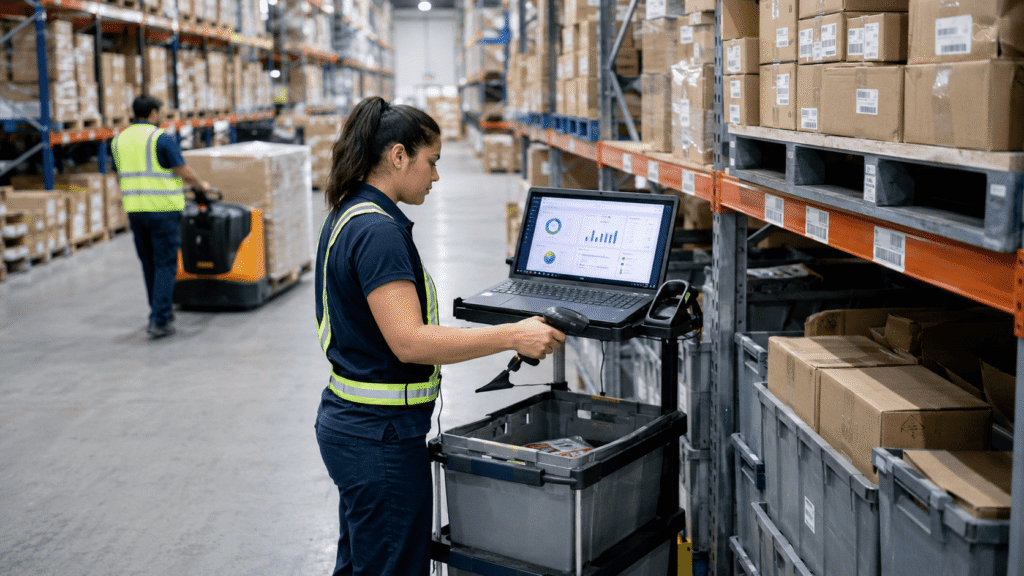
✅ Connect your systems. A WMS that integrates with your ERP, OMS, and sales channels keeps stock data aligned in one place. Nimbl’s integrated supply network supports 100+ pre-built integrations, so order, inventory, and shipping data sync without manual re-entry.
✅ Replace manual counts with scan-based capture. Barcodes and RFID tags update records at every touchpoint, like receiving, putaway, picking, and packing, so the system reflects the floor, not yesterday’s spreadsheet.
✅ Pair data with operational discipline. Real-time information only matters if teams act on it. Standardized SOPs for cycle counts, exception handling, and reconciliation turn raw data into reliable execution.
For brands without the volume or capital to build this in-house, an experienced 3PL provider can deliver the technology and the discipline as a packaged capability.
Build A Stronger Stock Picture With Nimbl
Real-time stock data is no longer a nice-to-have; it is the foundation for accurate fulfillment, lean operations, and resilient supply chains. Nimbl provides inventory visibility as part of our 3PL services, with WMS-driven workflows, 100+ integrations, and the discipline to keep your data and your stock aligned.
FAQs
What Does Inventory Visibility Mean?
Inventory visibility means knowing where stock is, how much is available, and how it moves across channels. It helps brands make faster decisions, prevent stockouts, and fulfill orders accurately.
Why Is Inventory Visibility Important?
It prevents stockouts, reduces excess stock, improves order accuracy, and protects customer commitments. It also lowers carrying costs and lets supply chain teams respond to disruption faster.
What Are The 5 Benefits Of Inventory Management?
The five most-cited benefits are reduced carrying costs, fewer stockouts, faster fulfillment, better demand forecasting, and improved customer satisfaction.
What Is The Difference Between Inventory Tracking And Inventory Visibility?
Tracking records movements at specific points, like receiving or shipping. A real-time view goes further. It provides continuous insight across every node, channel, and status, so teams always know what is available, reserved, in transit, or returned.
How Does Real-Time Inventory Visibility Help Omnichannel Brands?
It prevents the same unit from being sold across multiple channels by reserving stock at the moment of commitment. This protects available-to-promise accuracy across DTC, retail, marketplaces, and wholesale, reducing oversells, cancellations, and chargebacks.
Can A 3PL Improve Inventory Visibility?
Yes. A modern 3PL delivers the WMS, integrations, and scan-verified workflows that produce a real-time view, often faster and at lower capital cost than building them in-house.