The choice between 3PL vs 4PL shapes how a brand scales; how fast it ships, how much control it keeps, and how much of the supply chain it hands to an outside partner. Both outsource logistics, but at different altitudes. A third-party logistics provider runs the day-to-day movement of goods; a fourth-party logistics provider designs and directs the whole operation, often managing several 3PLs at once.
This guide covers the 3PL vs 4PL meaning in plain terms, explains what is a 3PL and a 4PL are in detail, walks through the logistics ladder from 1PL to 5PL, and lays out how to decide which model fits your supply chain management needs. The difference is less a definition than a growth decision: the model a company picks shapes how efficiently it scales.
TL;DR
- A 3PL executes the physical logistics work (warehousing, pick and pack, kitting, shipping, and returns) while the client keeps strategic control.
- A 4PL manages the whole chain, coordinating multiple 3PLs and other vendors as a single point of contact.
- Scope and control are the core difference: a 3PL runs the work; a 4PL designs and directs it.
- 3PLs are asset-based (warehouses, fleets); 4PLs are asset-light, competing on strategy, data, and technology.
- Start with a 3PL, scale toward a 4PL as the network spans more partners, regions, and channels.
- Complexity decides: simple fulfillment points to a 3PL; multi-partner, multi-region networks point to a 4PL.
What Is 3PL?
A third-party logistics (3PL) provider handles the physical execution of logistics on a company’s behalf. That covers receiving and storing inventory, pick and pack, order fulfillment, shipping, and returns management. Most 3PLs are asset-based; they own or operate the warehouses, equipment, and sometimes the transportation that moves a client’s goods.
The appeal is operational, not strategic. A brand outsources the warehouse and the shipping labor, keeps control of strategy, and frees up capital it would otherwise sink into space, systems, and staff. For a growing ecommerce brand, it is what makes fast national shipping possible without building a network from scratch.
Common 3PL services include:
- Warehousing and inventory storage across one or more fulfillment centers.
- Picking, packing, and shipping for direct-to-consumer and retail orders.
- Returns and reverse logistics handling after the sale.
- Freight and transportation arrangement, domestic and international.
💡 For the model to work, the 3PL’s systems have to “talk” to the brand’s store, order, and inventory platforms, a process known as 3PL integration that keeps stock counts and order status accurate in real time.
What Is 4PL?
A fourth-party logistics (4PL) provider manages the entire supply chain, not just the shipping. Sometimes called a lead logistics provider or a control tower, a 4PL owns the strategy, the technology, and the vendor relationships rather than the physical assets.
A 4PL selects, coordinates, and benchmarks the 3PLs and carriers doing the hands-on work, and gives the client one point of contact and one view of the whole network. In plain words: the 4PL directs the 3PLs beneath it.
They:
- design the network,
- integrate the systems that feed it data,
- measure performance across every partner.
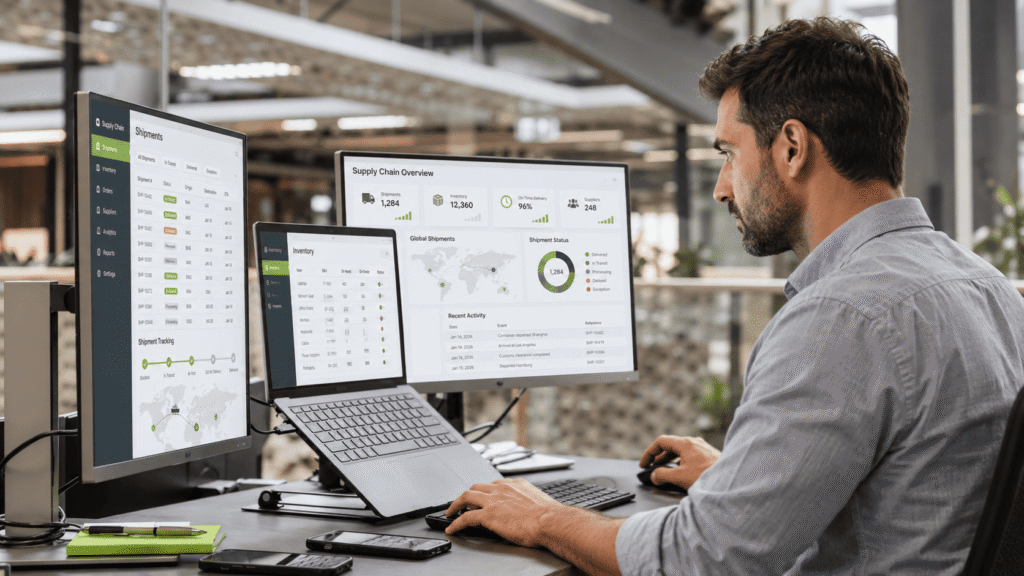
That connected view turns scattered vendor updates into usable inventory visibility. When something breaks, the 4PL is accountable for the outcome; not just the leg of the journey it happened to touch.
💡 Demand for this model is climbing. The 4PL market was worth roughly USD 72 billion in 2025 and is projected to near USD 145 billion by 2035. That is a sign of how much complexity brands are handing to one strategic partner.
The Logistics Ladder: 1PL To 5PL
Logistics outsourcing runs along a spectrum, from doing everything in-house to handing a whole network to a technology-led orchestrator. Comparing 1PL vs 2PL vs 3PL vs 4PL and the newer 5PL places the difference in context. Each “party” describes how much of the logistics function a company outsources.
1PL vs 2PL vs 3PL vs 4PL vs 5PL
| Model | What It Means | Who Controls What |
|---|---|---|
| 1PL | First-party logistics: the company moves its own goods with its own assets | Full control, full cost, and asset burden |
| 2PL | Second-party logistics: a carrier is hired to transport goods point to point | Company plans; carrier executes transport |
| 3PL | Third-party logistics: a provider runs warehousing, fulfillment, and shipping | Company keeps strategy; 3PL runs operations |
| 4PL | Fourth-party logistics: a partner orchestrates the chain and manages the 3PLs | Partner directs; client keeps oversight |
| 5PL | Fifth-party logistics: technology-led orchestration across multiple supply chains | Provider optimizes networks at scale |
4PL vs 3PL: The Core Differences
The difference between 3PL and 4PL comes down to scope, control, and accountability. A 3PL is transactional and execution-focused, doing the specific jobs it is contracted to do. A 4PL is strategic, taking responsibility for the whole outcome and managing the providers underneath it. Put plainly, a 3PL runs the work and a 4PL designs and directs it.
The Difference Between 3PL And 4PL Logistics – Comparison Table
| Factor | 3PL | 4PL |
|---|---|---|
| Primary Role | Executes daily logistics operations | Orchestrates the entire supply chain |
| Scope | Warehousing, fulfillment, shipping, returns | Planning, vendor management, network design |
| Assets | Usually asset-based (warehouses, fleet) | Typically asset-light |
| Point of Contact | Manages its own services | Single contact across all providers |
| Technology | Operational systems and tracking | Analytics, forecasting, full-network visibility |
| Relationship | Transactional, per-service | Strategic, long-term partnership |
| Best For | Growing brands needing execution | Complex, multi-partner supply chains |
In practice, 3PL and 4PL logistics often coexist.
Should You Work With A 3PL Or 4PL?
Whether to work with a 3PL or 4PL depends on the complexity of the operation, not its size alone.
A 3PL is usually the right fit when a company:
- Needs reliable execution of warehousing, fulfillment, and shipping without building it in-house.
- Still has internal capacity to own supply-chain strategy and vendor decisions.
- Runs a relatively contained network, one or a few fulfillment centers and a handful of channels.
A 4PL tends to make sense when a company:
- Operates a complex, multi-partner network across regions, carriers, or business units.
- Lacks in-house expertise, or wants to consolidate oversight under one partner.
- Needs aggregated data and accountability across many vendors, not just one warehouse.
The honest answer is often “a 3PL now, a 4PL later.” But 3PL and 4PL logistics often coexist, and the same partner can provide both. Nimbl, for example, combines day-to-day warehousing, fulfillment, and shipping with broader coordination of carriers, logistics providers, and connected systems. Working with a partner that offers both gives you one point of accountability and clearer visibility across your operations. That means less coordination for your team, faster issue resolution, and better control over costs as your business grows.
Build A Stronger Supply Chain With Nimbl
Choosing between 3PL and 4PL depends on your stage of growth. Nimbl provides both, combining warehousing and fulfillment with coordination across carriers, providers, and systems as your network expands. We connect daily execution with broader operational oversight.
So, is your logistics partner equipped to support the next stage of your growth?
FAQs
What Is The Difference Between 3PL And 4PL?
A 3PL executes logistics operations like warehousing, fulfillment, and shipping, while a 4PL manages the entire supply chain and coordinates multiple 3PLs. In short, a 3PL runs the work and a 4PL designs and directs it across every partner.
What Are 1PL, 2PL, 3PL, 4PL, And 5PL?
They describe how much logistics a company outsources. A 1PL handles everything in-house, a 2PL adds a carrier for transport, a 3PL outsources fulfillment, a 4PL orchestrates the whole chain, and a 5PL coordinates multiple supply chains through technology.
Is A 4PL More Expensive Than A 3PL?
A 4PL usually carries a higher management fee because it oversees strategy and vendors. But it can lower total supply-chain costs by consolidating providers, improving visibility, and removing duplicated effort across a complex, multi-partner network.
Can A Business Use Both A 3PL And A 4PL?
Yes, and many do. A 4PL commonly manages several 3PLs at once, integrating their data and benchmarking performance. Companies often begin with a single 3PL and add 4PL oversight as their network grows more complex.
Should A Small Ecommerce Brand Choose A 3PL Or 4PL?
Most small and mid-size ecommerce brands are best served by a 3PL, which delivers reliable fulfillment without heavy overhead. A 4PL becomes worthwhile once a brand juggles many carriers, regions, or business units at once.