Trucking remains the backbone of North American surface freight. In 2024, surface transportation accounted for 77.1% of cross-border freight value, while overall freight demand continues to be tracked through the federal Freight Transportation Services Index.
Choosing between LTL vs FTL shipping, though, starts with one practical question: does your freight need a full truck, or only part of one?
The difference is in how each mode is priced, scheduled, and handled. LTL shipping lets you share trailer space with other shipments, which can lower costs for smaller loads. FTL shipping gives your freight the full truck, which can improve speed, control, and protection.
Choosing the wrong mode can quietly cut into the margin. You may overpay for unused trailer space, accept longer delivery windows, or increase the risk of damage from extra handling. This guide breaks down how LTL and FTL shipping compare across cost, transit time, handling, and shipment size, so you can choose the right option with more confidence.
TL;DR
- LTL means less-than-truckload. Your freight shares trailer space with other shippers, and you pay only for the portion you use.
- FTL means full truckload. One shipper reserves the entire trailer, even if the load doesn’t fully occupy it.
- Pallet count is the fastest rule of thumb: one to six pallets usually points to LTL, while seven or more leans toward volume LTL or FTL.
- LTL is cheaper for small loads; FTL is faster and lower-risk for large, fragile, or time-sensitive freight moving from an ecommerce distribution center to retail partners, marketplaces, or wholesale destinations.
- Pricing works differently: LTL is quoted on freight class, while FTL is generally priced per mile.
What Is Full Truckload (FTL) Shipping?
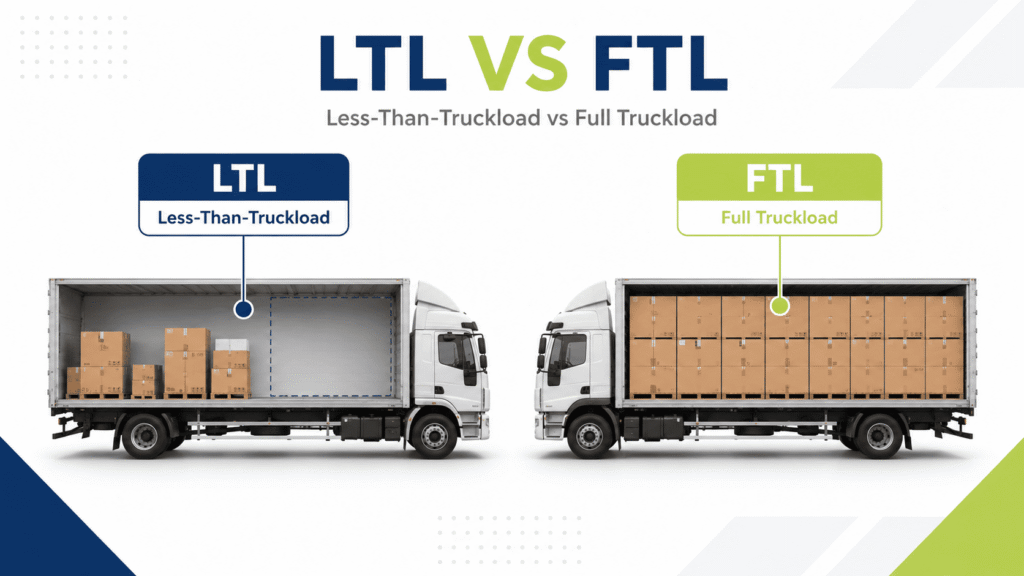
Full truckload (FTL) shipping – sometimes written as TL or OTR (over the road) – means exclusive use of the truck by a single shipper. The most common equipment is a Class 8 tractor pulling a 53-foot dry van, the largest trailer permitted on most U.S. interstates under federal truck size and weight standards that cap gross vehicle weight at 80,000 pounds.
With FTL, you reserve the full capacity of the truck even if your goods don’t fill every inch. The trailer is loaded at the point of origin, sealed, and driven straight to the destination without sharing space with anyone else’s freight. That exclusivity is the defining feature: your shipment stays on one truck, in one set of hands, from pickup to delivery.
📝 Note: FTL becomes the standard choice once a shipment approaches a full 53-foot trailer or roughly 12 or more pallets.
What Is Less-Than-Truckload (LTL) Shipping?
Less-than-truckload (LTL) shipping is the opposite arrangement: several shippers’ freight rides on the same trailer, and each pays only for the space their goods occupy. LTL shipments typically range from about 150 to 15,000 pounds, or one to six pallets; too large for parcel carriers, but not enough to justify a dedicated truck.
Because the carrier consolidates multiple shipments, an LTL load rarely travels straight to its destination. It moves through regional terminals, where it may be unloaded, sorted, and reloaded several times before final delivery. That hub-and-spoke routing is what keeps LTL affordable, and it also explains the trade-offs covered below.
📝 Note: Shipments larger than six pallets but smaller than a full load often fall into volume LTL or partial truckload; a middle tier many carriers price between standard LTL and FTL.
LTL vs FTL vs Partial Load: The Key Differences
While all three modes use the same highways and the same Class 8 trucks, the experience of shipping FTL vs LTL freight vs Partial Load diverges across five practical factors: cost, pricing method, transit time, handling, and capacity. The table below summarizes the comparison, and the points that follow add the operational detail.
| Factor | LTL (Less-Than-Truckload) | PTL (Partial Truckload) | FTL (Full Truckload) |
| Truck Space | Shared with other shippers | Shared or partially dedicated trailer space | Entire trailer reserved |
| Typical Size | 1-6 pallets, ~150-15,000 lbs | Larger than LTL, but not enough for a full trailer | Large loads up to a full 53-ft trailer |
| Pricing Basis | Freight class, weight, dimensions | Space used, linear feet, weight, lane, and carrier capacity | Generally priced per mile |
| Transit & Predictability | Multiple stops; wider delivery windows | Fewer stops than LTL; more predictable than standard LTL | Direct route; firm appointments |
| Handling / Damage Risk | Higher, loaded and unloaded repeatedly | Lower than LTL, usually fewer touchpoints | Lower, sealed from origin to destination |
| Best For | Smaller, sturdy, flexible-timeline loads | Mid-sized shipments that are too large for LTL but too small for FTL | Large, fragile, high-value, or time-sensitive loads |
Cost & Pricing
LTL is usually cheaper for small shipments because you split the cost of the truck with other shippers. Its rate is calculated on freight class, a standardized rating based on weight, density, stowability, handling, and liability, alongside dimensions and distance. FTL is typically quoted per mile, which means a half-empty reserved truck costs roughly the same as a full one.
📝 Note: LTL can reduce base freight cost, but shippers should also account for accessorial charges. Services such as liftgate delivery, limited-access pickup, inside delivery, detention, or appointment requirements can change the final cost. The lowest LTL quote is not always the lowest landed cost if the shipment needs special handling.
Transit Time & Predictability
A full truckload goes directly from pickup to delivery, so transit is predictable, and carriers can commit to firm appointment times. LTL freight makes multiple stops, which widens both pickup and delivery windows. Driver schedules on either mode are also bound by federal hours-of-service limits that cap daily driving time and shape realistic transit estimates.
Handling & Damage Risk
Because an FTL shipment is sealed at origin and untouched until delivery, it faces minimal handling. LTL freight is loaded and unloaded at every terminal it passes through, and each touch adds a chance of damage. This is why fragile or high-value goods often favor a dedicated truck. The same handling logic applies in reverse when products flow back through reverse logistics.
When Should You Use LTL?
LTL tends to win when the shipment is small, and the timeline is flexible:
- Six pallets or fewer: Your load doesn’t come close to filling a trailer.
- Sturdy or well-packaged freight: Your goods can tolerate repeated handling.
- Flexible delivery timing: A wider delivery window won’t disrupt your operation.
- Cost is the priority: Paying only for the space you use protects margin on smaller orders.
When Should You Use FTL?
FTL is the better fit when volume, fragility, or timing raise the stakes:
- Twelve pallets or more: The load justifies a dedicated trailer, and economies of scale make the per-unit cost competitive.
- Fragile or high-value goods: Keeping freight on one sealed truck limits damage exposure.
- Firm pickup and delivery dates: A single direct route supports committed appointments.
- Time-sensitive shipments: Direct transit is the most reliable way to hit a hard deadline.
Match Every Shipment To The Right Shipping Mode With Nimbl
Getting LTL vs. FTL right helps protect fulfillment margins on every order. Nimbl uses nationwide carrier options and a central Salt Lake City fulfillment hub to match each shipment with the mode that fits its size, timeline, and destination. From a single LTL pallet to a full truckload headed into retail distribution, we move orders with precision, control, and cost discipline.
Frequently Asked Questions
What Is The Difference Between FTL And FCL?
FTL (full truckload) is a road mode where one shipper books an entire trailer. FCL (full container load) is an ocean mode where one shipper books an entire shipping container. FTL moves by truck; FCL moves by sea.
Is FedEx LTL Or FTL?
FedEx handles both, under different units. FedEx Freight focuses on LTL shipments, while truckload volume is brokered through FedEx’s logistics arm. Most shippers associate the FedEx Freight brand specifically with less-than-truckload service.
How Many Pallets Are Considered LTL?
LTL generally covers one to six pallets, or shipments under roughly 12 linear feet of trailer space. Above that, freight usually shifts to volume LTL or partial truckload, and a near-full load becomes a candidate for FTL.
Is LTL Or FTL More Expensive?
It depends on volume. LTL is cheaper for small loads because you pay only for the space used. FTL costs more in total but is more cost-effective per unit once a shipment fills most of a trailer.
What Are The Four Types Of Freight?
Freight is commonly grouped into four categories by size: parcel (small packages), LTL (one to six pallets), partial or volume LTL (the mid-range), and FTL (a full or near-full trailer). Each suits a different shipment profile.