Lead time is one of the most-used and least-precisely-defined terms in logistics. In shipping, it describes the full stretch of time between the moment an order is placed and the moment it reaches its destination. It’s not just the days a package spends on a truck.
That distinction matters because the number shapes inventory planning, delivery promises, and customer trust. In this article, we explain the lead time meaning, how to calculate it, how it differs from cycle time and delivery time, and how businesses can shorten it across the supply chain.
TL;DR
- Lead time spans order to delivery. It covers processing, handling, and transit, not only the final shipping leg.
- The lead time formula is the delivery date minus the order date, or supply delay plus reordering delay for inventory planning.
- Cycle time is not lead time; cycle time measures active work on one unit, while lead time measures the whole start-to-finish process.
- Order and delivery lead time differ: the full customer wait vs. the final transport leg to the door.
- Shorter lead time comes from four levers: distributed inventory, reliable suppliers, automation, and disciplined fulfillment.
What Is Lead Time?
Lead time, in general, is the total time a process takes from start to finish. Investopedia defines it as the span between the initiation and completion of any process, whether that means sourcing raw materials, producing goods, or fulfilling a customer order.
To define lead time in a logistics setting, we need to measure the elapsed time from the point an order is placed to the point the goods are received. This shows how long capital stays tied up in orders still in motion, and how far ahead teams must plan replenishment.
What Does Lead Time Mean In Shipping?
In shipping and supply chain, lead time covers order processing, picking, packing, carrier handoff, and transit to the destination. Framing lead time in the supply chain this way keeps expectations realistic, because it accounts for every step a shopper actually waits through, not just the hours the parcel spends in a delivery van.
Lead time in shipping includes two parts:
- Work that moves the order forward: the steps that prepare, build, assemble, process, pick, pack, or ship the product.
- Time that slows the order down: waiting, transport gaps, approvals, inspections, handoffs, or queues where nothing is actively being completed.
💡 In real operations, those “in-between” delays often take up the biggest share of total lead time.
5 Types Of Lead Time
Lead time is not a single measurement. Different stages of the supply chain track different versions of it:
- Order lead time is the total time a customer waits from placing an order to receiving it. It is the figure that most directly shapes the customer experience.
- Delivery lead time is the transport leg specifically; the time from when goods leave the fulfillment center to when they arrive at the customer’s door.
- Material (procurement) lead time is the time it takes to source and receive raw materials or stock from a supplier.
- Production lead time is the time required to manufacture the goods once materials are on hand.
- Cumulative lead time combines all of the above, from the first raw-material order to final delivery.
Another way to categorize lead time is according to processing stage:
- Pre-processing,
- Processing,
- Post-processing.
📝 Note: A backorder is often a lead time problem in disguise. When procurement or production lead times run long, stock arrives late, and orders queue against inventory that is not yet on the shelf.
The Lead Time Formula & How To Calculate It
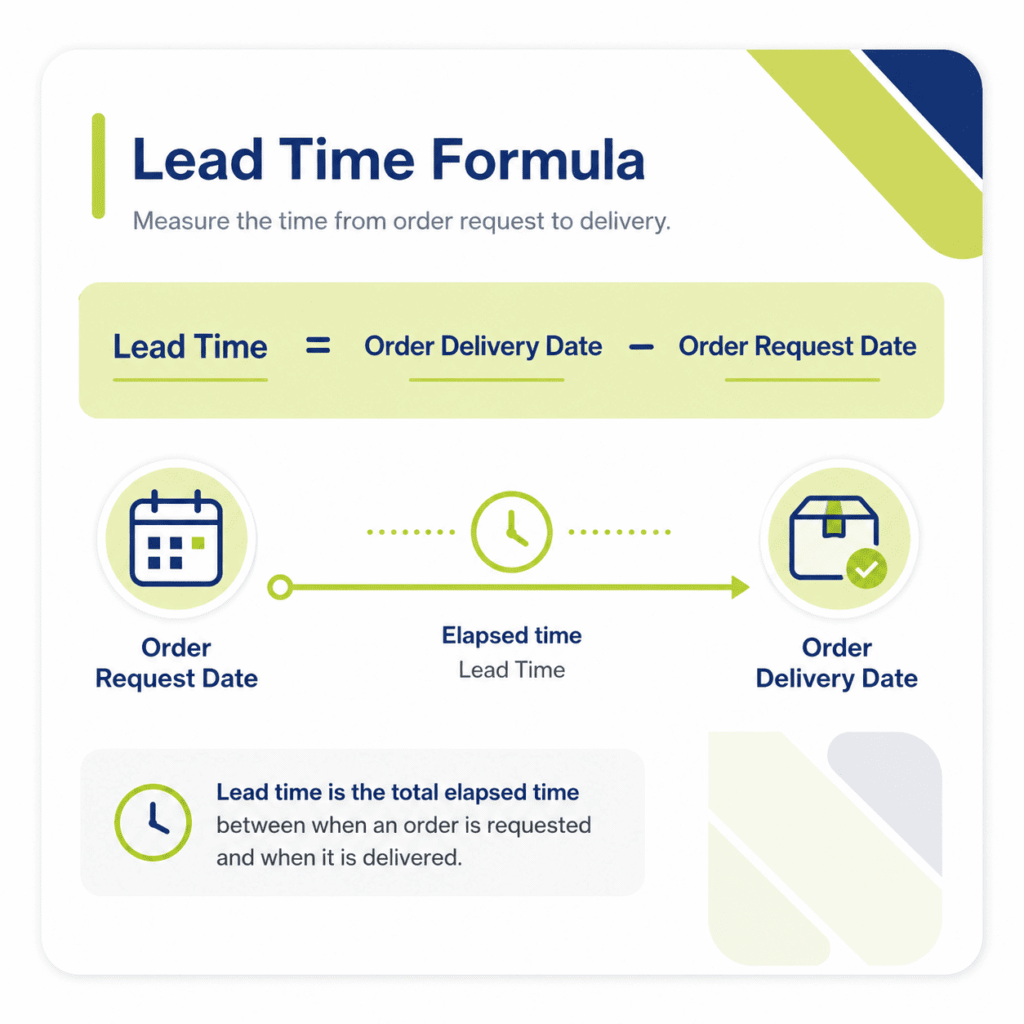
The basic lead time formula is straightforward:
Lead Time = Order Delivery Date − Order Request Date
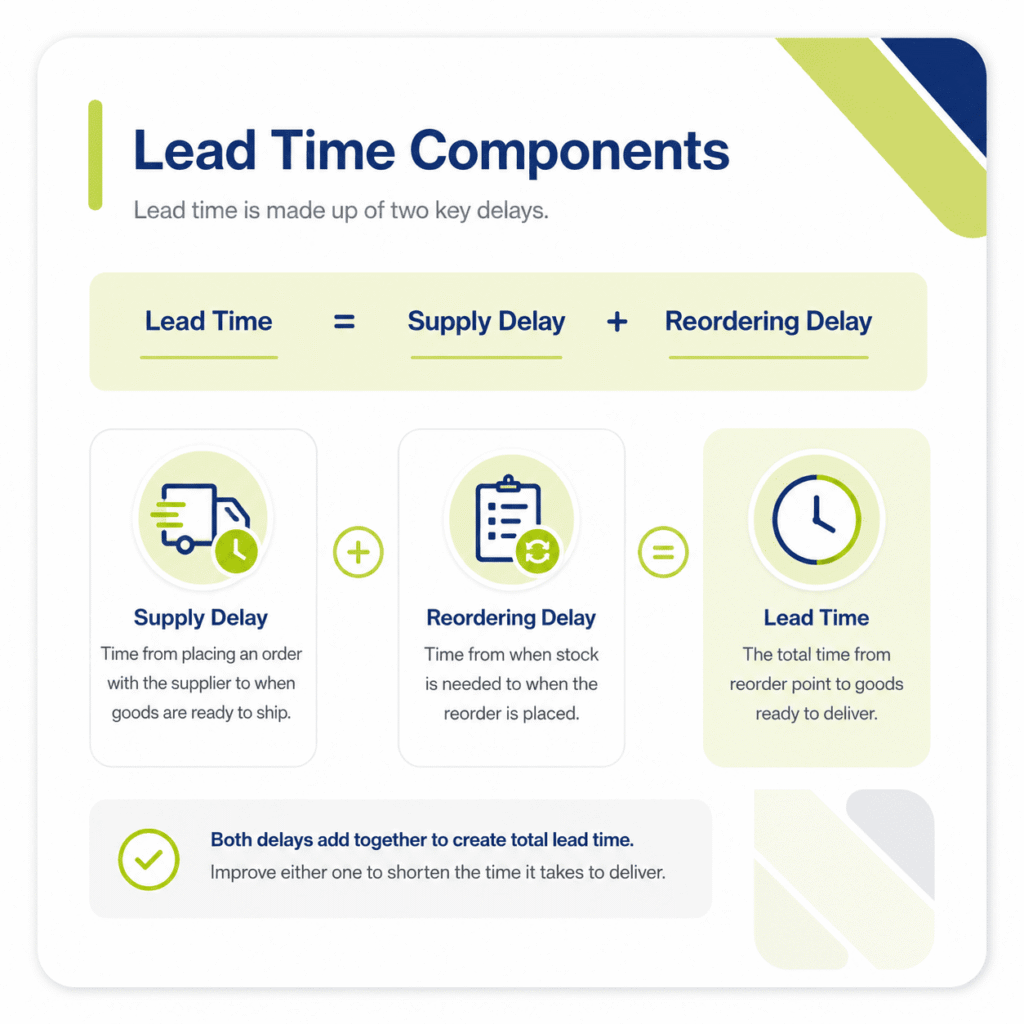
For inventory planning, teams often use a second version that separates the two delays behind replenishment:
Lead Time = Supply Delay + Reordering Delay
How To Calculate Lead Time: Calculation Example
A brand receives an online order on Monday morning. Picking and packing take one day, the carrier collects the parcel on Tuesday, and ground transit to the customer takes four business days. The lead time is five business days. Running the same lead time calculation across many orders reveals the average a business can realistically promise, and the buffer stock it should build in for disruptions.
What Affects Lead Time In Shipping?
Several moving parts can stretch or shorten shipping lead time.
Order processing speed matters first. If orders sit in a queue before picking starts, the customer is already waiting. Warehouse layout, inventory accuracy, picking efficiency, packing speed, carrier cutoff times, and system integrations all affect how quickly an order moves from checkout to carrier handoff.
Carrier choice also matters. Ground, expedited, LTL, FTL, and regional delivery networks all carry different timing, cost, and reliability tradeoffs. The same order can have a very different lead time depending on where inventory is stored, when the order is released, and whether the fulfillment system updates inventory and shipping data in real time.
Returns, exceptions, address issues, customs, weather, and missed delivery attempts can also extend total lead time. That is why reducing lead time is not only about choosing faster shipping. It is about removing friction before, during, and after the transportation stage.
Cycle Time vs Lead Time
Cycle time vs lead time is a distinction worth getting right, because the two are easy to confuse. Cycle time measures the active time it takes to complete one unit of work, from the moment production on that unit starts to the moment it finishes. Lead time measures the whole process, including the waiting, queuing, and transit that cycle time ignores.
Put another way, the lead time vs cycle time question comes down to scope: cycle time counts the work, while lead time counts the wait as well.
| Metric | What It Measures | Scope | Example |
|---|---|---|---|
| Lead Time | Total elapsed time from order to delivery | The entire process, including waiting and transit | 5 business days |
| Cycle Time | Active time to complete one unit | A single production step, no waiting | 3 hours per unit |
⚠️ Shortening cycle time helps, but lead time usually hides its biggest time waste in the waiting between steps, not in the work itself.
Why Lead Time Matters
Lead time drives the delivery experience. Average US parcel delivery speed accelerated by roughly 40% between early 2020 and mid-2023. With e-commerce making up about 16.4% of US retail sales as of late 2025 per the U.S. Census Bureau, and delivery-speed expectations still climbing among younger shoppers, predictable lead times separate brands that retain customers from those that lose them to a faster competitor.
A delivery exception, like a delay, misroute, or failed attempt, stretches delivery lead time and erodes that trust.
How To Reduce Lead Time In The Supply Chain
Not every part of lead time is controllable, but several levers can shorten it. Here is how to reduce lead time in the supply chain in practice:
- Distribute inventory closer to customers. Shipping zones are priced by distance, so positioning stock across regional nodes cuts both transit time and cost. A fulfillment center in Utah, for example, can reach much of the Western US in one to three days by ground.
- Strengthen supplier relationships and keep backups. Reliable suppliers with shorter, more consistent lead times reduce the safety stock a business must carry, and a backup source protects against disruption.
- Automate order processing. Same-day pick and pack fulfillment and real-time inventory data remove the manual delays that quietly extend lead time before a carrier is ever involved.
- Use lean, just-in-time replenishment. A just-in-time approach orders stock closer to when it is needed and requires a coordinated cross-docking strategy. Though it works only when lead times are predictable enough to avoid backorders and stockouts.
- Match the shipping mode to the urgency. Choosing between LTL and FTL freight or offering expedited shipping lets a business trade cost for speed when a shipment is time-sensitive.
- Partner with a 3PL. A third-party logistics provider with pre-negotiated carrier rates and integrated ecommerce fulfillment systems absorbs much of the complexity that lengthens lead time in-house.
How To Reduce Your Lead Time In Supply Chain With Nimbl
Lead time only shrinks when every step behind it runs cleanly. Nimbl plugs into your operation like an in-house fulfillment team, keeping orders moving from checkout to doorstep with accuracy, visibility, and control.
From two fulfillment centers – Salt Lake City, Utah, and Lebanon, Tennessee – its lean, adaptive 3PL logistics solutions position inventory closer to customers, automate order processing, and keep delivery lead times short and predictable.
Frequently Asked Questions
What Is The Lead Time For Delivery?
Delivery lead time is the time from when an order leaves the fulfillment center to when it reaches the customer. For domestic ground shipments, it typically runs one to five business days, depending on distance and carrier.
Does Lead Time Include Shipping?
Yes, lead time includes shipping when measured from order placement to final delivery. In fulfillment, it often covers processing, picking, packing, carrier transit, and delivery.
What Does 1 Week Lead Time Mean?
A one-week lead time means roughly seven days pass between placing an order and receiving it. It usually covers order processing, handling, and transit combined, so the item should arrive about a week after the order is confirmed.
What Is An Example Of A Lead Time?
A retailer orders 500 units from a supplier on Monday. The stock arrives the following Friday. The lead time is four business days from order placement to receipt.
What Is The Difference Between Lead Time And Delivery Time?
Lead time is the full span from order placement to receipt, including processing and handling. Delivery time is narrower, covering only the transport leg from carrier pickup to the door. First-mile and last-mile delivery time are both part of total lead time.
What Is The Difference Between Production Time And Lead Time?
Production time is only the stretch spent manufacturing goods. Lead time is broader, including procurement, production, and shipping. Production is one contributor to total lead time, which is why a short production run can still sit inside a long lead time.
What Does 4-Hour Lead Time Mean?
A four-hour lead time means a process finishes about four hours after it begins. For example, an order placed at 10 a.m. should be ready, shipped, or delivered around 2 p.m.