Inventory control is the discipline of managing the stock a business already holds; knowing what is on hand, where it sits, and when to replenish it. Get it right, and orders will ship on time. Capital stays free, and warehouses run clean. When inventory falls out of control, warehouses carry the cost through missed sales, aging stock, and margin erosion.
This article explains what stock control is, how it differs from inventory management, the main methods and techniques operators rely on, and why it sits at the center of a healthy supply chain. Whether you run a single stockroom or a multi-site distribution network, the same fundamentals apply.
TL;DR
- Inventory control tracks stock on hand, like quantities, locations, and condition, and sets the rules that trigger replenishment.
- It is a subset of inventory management, the broader discipline covering forecasting, procurement, and the full inventory lifecycle.
- Two systems dominate: periodic (scheduled physical counts) and perpetual (continuous, automated tracking).
- Inventory control is not one-size-fits-all. FIFO/LIFO, EOQ, JIT, safety stock, reorder points, and ABC analysis each solve a different pressure point in demand, cash flow, and warehouse execution.
- Strong controls protect inventory accuracy and keep losses from spreading quietly. It prevents stockouts and frees working capital tied up in excess stock.
What Is Inventory Control?
Inventory control, also called stock control, is the process of managing and coordinating the goods a business already owns so the right items are available in the right quantity, at the right place, at the right time. The inventory control definition used across supply-chain literature centers on one balancing act: holding enough stock to meet demand without tying up cash or warehouse space in excess.
💡 In plain terms, the inventory control meaning comes down to visibility and discipline: counting what you have, recording every movement, and acting on that data. At its core, it answers three questions:
- What do we have?
- Where is it?
- When do we reorder?
Inventory Control vs Inventory Management
Control versus management is one of the most common points of confusion in logistics, because the two terms are different pieces of the same puzzle. They are related but not identical. Stock control is the operational layer regulating and handling the goods physically on hand today. Inventory management is the broader, strategic discipline that spans the full lifecycle: procurement, demand forecasting, replenishment, and turnover.
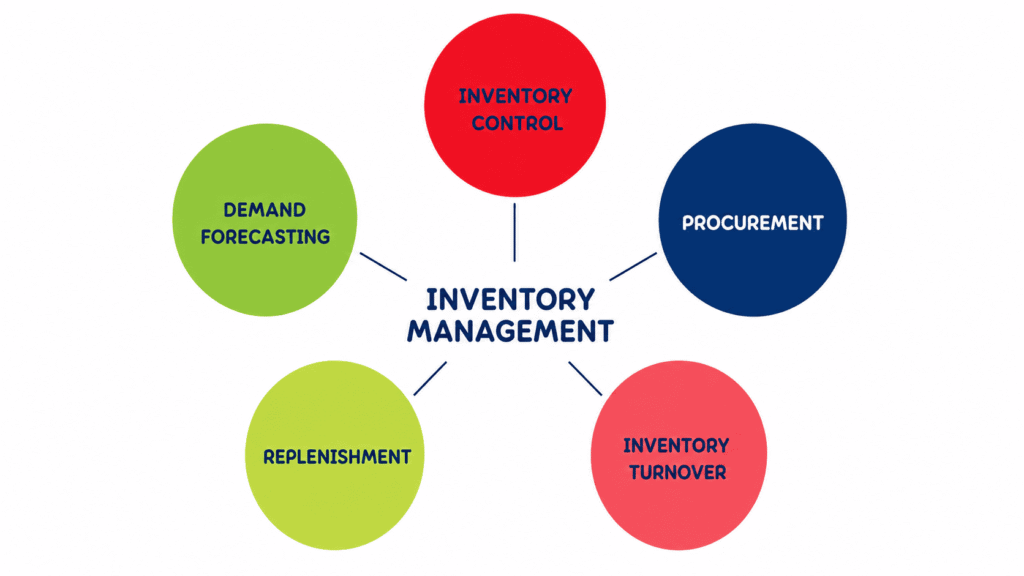
Put simply, basic inventory control is a subset of inventory management. You cannot forecast or plan reliably on top of counts you do not trust, which is why getting it right is the foundation for everything above it.
The relationship between inventory management and inventory control is layered, not competitive, and depends on them both working together.
| Aspect | Control | Management |
|---|---|---|
| Scope | Stock physically on hand | The full inventory lifecycle |
| Focus | Tracking, storage, accuracy, replenishment triggers | Forecasting, planning, procurement, turnover |
| Time Horizon | Day-to-day, operational | Strategic, long-range |
| Core Question | “What do we have, and where?” | “What should we buy, and when?” |
| Example Activity | Cycle counts, bin organization, reorder points | Demand forecasting, supplier strategy, turnover analysis |
Why Is Inventory Control Important?
The reason is simple: inventory is usually one of the largest assets on a company’s balance sheet, and small errors compound into real money. The purpose of inventory control is to protect that asset, minimizing the capital locked in stock while still meeting demand.
The downside of weak control is measurable. U.S. retailers lose an estimated $112 billion a year to inventory shrinkage, driven partly by poor stock-handling and record-keeping. Stockouts cut the other way: In 2024, an EU discount retailer, Pepco Group, reported that delayed and inconsistent stock availability contributed to a 3.1% decline in like-for-like revenue, showing how inventory gaps can quickly translate into lost sales.
Across the economy, businesses hold close to 1.4 months of inventory relative to sales on average; capital that only pays off when it is managed precisely.
Done well, control delivers on the upside too: cleaner inventory visibility, fewer backorders, faster warehouse throughput, and stronger cash flow. Many operations target 97% or higher stock accuracy and use frequent counts to sustain it.
Stock Control Methods: Periodic vs Perpetual
The main inventory control methods rest on two foundational systems that decide how often you know your true stock position.
Periodic Inventory
Periodic inventory relies on physical counts taken at set intervals – weekly, monthly, quarterly, or annually. Between counts, levels are not tracked in real time. It is inexpensive and simple, which suits small businesses with stable, low-volume stock, but it offers less accountability and a higher risk of undetected discrepancies.
Perpetual Inventory
Perpetual inventory tracks stock continuously and automatically, updating records the moment an item is received, sold, or moved. It requires software and scanning hardware, so it costs more to run, but it delivers near-real-time accuracy and is effectively mandatory for multichannel ecommerce. Most growing operations run perpetual systems and still schedule cycle counts to correct drift.
Barcodes and RFID tags are the practical minimum, letting teams capture every movement without manual re-keying. Nimbl’s 3PL services run on WMS-enabled perpetual tracking for exactly this reason.
Retail Inventory Control Techniques
Beyond the system you choose, a set of proven techniques governs how and when you order. Knowing how to control inventory is largely a matter of matching the right technique to your demand pattern.
- FIFO and LIFO define how stock value flows. FIFO and LIFO (first-in-first-out and last-in-first-out) set which units count as sold first. FIFO suits perishables and dated goods; LIFO is permitted only under U.S. GAAP, not international standards.
- EOQ, the economic order quantity, finds the order size that minimizes total holding and ordering costs. It works best for predictable demand and stable costs.
- JIT, or just-in-time, keeps only enough stock to meet immediate needs, cutting holding costs but leaning heavily on reliable suppliers and accurate forecasts.
- Safety stock and reorder points absorb variability. The reorder point equals demand during lead time plus safety stock: an item selling 20 units a day with a five-day lead time reorders at 100 units, before any buffer.
- ABC analysis ranks items by value and velocity, so attention and count frequency go where they matter most.
- Par levels and two-bin systems trigger replenishment automatically when stock drops to a set threshold.
There is no single best technique. Most operations combine them: EOQ for steady sellers, JIT for fast movers, and safety stock for items vulnerable to supplier delays.
Common Stock-Control Challenges
Even with the right system in place, a few problems recur across warehouses and stockrooms:
- Balancing stock levels: too little triggers stockouts, while too much ties up capital in carrying costs and risks obsolescence.
- Keeping data accurate: manual entry drifts over time, so physical records and system counts quietly diverge.
- Optimizing placement: where each SKU sits across locations affects pick speed, labor, and shipping cost.
- Tracking movement in real time: every receipt, pick, transfer, and return has to be captured to keep counts trustworthy.
How To Build A Reliable Warehouse Inventory Control Process
A dependable inventory control process turns these methods into repeatable procedures. The steps below work whether you are formalizing basic stock control or tightening a mature operation.
- Tag and organize every item with SKUs and barcodes or RFID, and assign clear storage locations.
- Choose a tracking system and commit to keeping its records current.
- Set reorder points and par levels for each SKU based on sales velocity and supplier lead time.
- Build in demand forecasting so replenishment reflects real trends. Strong demand forecasting turns control from reactive to proactive.
- Audit continuously using cycle counts rather than a single year-end freeze, checking high-value items most often.
- Review and refine as demand, suppliers, and SKUs change, tightening replenishment rules over time.
Take Control Of Your Inventory With Nimbl
Strong stock control only works when accurate counts translate into on-time execution. Nimbl moves orders from checkout to customer doorsteps with precision and control, pairing lean, adaptive fulfillment with real-time visibility, WMS-enabled workflows, and cycle-count discipline.
From ecommerce fulfillment to B2B and wholesale distribution, Nimbl gives growing brands the control to serve every channel confidently.
Frequently Asked Questions
What Does Inventory Control Mean?
It means managing the stock a business already holds by tracking quantities, locations, and condition, and setting the rules that trigger replenishment, so the right items stay available without overstocking. It is the day-to-day operational core of wider inventory management.
What Is The Purpose Of Inventory Control?
Inventory control keeps the right products available in the right quantities, protecting cash flow, preventing stockouts and overstock, and supporting accurate, on-time fulfillment across channels.
What Are The 4 Types Of Inventory Control?
Practitioners often cite four core approaches: periodic counting, perpetual tracking, and the two flow-and-valuation methods, FIFO and LIFO. Layered techniques such as EOQ, JIT, safety stock, and ABC analysis then refine exactly how and when stock is reordered.
What Is The Role Of An Inventory Controller?
An inventory controller safeguards stock accuracy and availability. They run counts and audits, set reorder points and par levels, reconcile discrepancies, coordinate with purchasing and warehouse teams, and analyze data to prevent both costly stockouts and excess overstock.
What Is Inventory In Simple Words?
Inventory is all the goods and materials a business keeps to sell or use in production, from raw components to finished products sitting on a shelf, in a stockroom, or across a warehouse waiting to be picked and shipped.